

If you have come across the phrase bounce media groupcom social stat while researching social media analytics, you are not alone. It shows up in marketing forums, competitor audits, and analytics discussions as shorthand for a broader idea: tracking and understanding how a brand performs across social platforms.
This guide breaks down what the term means, why it keeps appearing in searches, how the underlying tracking process works, and how you can apply the same thinking to your own social media growth strategy. No fluff — just a practical, easy-to-follow explanation.
What It Is
At its core, bouncemediagroupcom social stat refers to a collection of social media performance data — the kind of numbers that show how an account or brand is doing across platforms like Instagram, Facebook, X (formerly Twitter), TikTok, and LinkedIn.
Rather than being one single number, it’s a snapshot made up of multiple data points:
- Follower counts
- Engagement (likes, comments, shares)
- Impressions and reach
- Referral traffic to a website
- Content performance by post type
Think of it as a report card for a brand’s social presence — one that tells you not just how many people are watching, but how they’re reacting.
Why People Search for It
Most people who search this exact phrase fall into a few groups:
- Marketers auditing competitors — trying to understand what a strong social stats report looks like.
- Digital creators — curious how their own numbers compare to industry benchmarks.
- Students and researchers — studying social media analytics as a topic for coursework or content.
- Business owners — looking for a simple explanation of social metrics without needing a marketing degree.
The interest keeps growing because social media has become a core part of brand visibility, and terms like this one act as an easy entry point into a much bigger analytics conversation.
How It Works

Social stat tracking generally follows a simple process, whether it’s applied to a specific brand or used as a general analytics model:
- Data collection — Information is pulled from social platforms using APIs, tracking pixels, or built-in analytics dashboards.
- Data organization — Raw numbers are sorted into categories: followers, engagement, reach, clicks, and conversions.
- Data visualization — Dashboards convert numbers into charts and graphs that are easier to interpret.
- Analysis — Patterns are identified — which content performs well, which days get better engagement, which platform drives the most traffic.
- Action — Insights are used to adjust posting schedules, content style, or ad spend.
This cycle repeats continuously, which is why social stats are described as a living dataset rather than a one-time report.
Key Metrics
Here is a quick breakdown of the metrics most commonly included in a social stats overview:
| Metric | What It Measures | Why It Matters |
|---|---|---|
| Follower Count | Total audience size | Indicates reach potential |
| Engagement Rate | Likes, comments, shares relative to followers | Shows content relevance |
| Impressions | Number of times content is displayed | Measures visibility |
| Reach | Unique users who saw the content | Shows audience spread |
| Click-Through Rate (CTR) | Clicks divided by impressions | Measures interest and intent |
| Referral Traffic | Visitors sent from social to a website | Connects social activity to business goals |
| Conversion Rate | Actions taken after clicking through | Ties social performance to revenue |
Why It Matters
Social stats matter because they replace guesswork with evidence. Instead of assuming a post “did well” because it felt popular, data shows exactly how it performed compared to previous content.
For businesses, this translates into:
- Smarter budget allocation for paid campaigns
- Better timing for content publishing
- Clearer understanding of audience preferences
- Early detection of declining engagement before it becomes a bigger problem
Benefits

Tracking social stats consistently offers several practical advantages:
- Improved content strategy — you learn what your audience actually responds to.
- Better ROI tracking — you can connect social effort to real business outcomes.
- Competitive benchmarking — you can compare your growth against industry averages.
- Faster problem detection — sudden engagement drops become visible quickly.
- Data-backed decision making — reduces reliance on assumptions or trends alone.
Who Can Use It
This approach isn’t limited to large corporations. It applies broadly across:
- Small business owners managing their own social pages
- Marketing agencies overseeing multiple client accounts
- Content creators and influencers tracking personal brand growth
- E-commerce brands linking social activity to sales
- Nonprofits measuring awareness campaigns
- Students and analysts studying digital marketing trends
Anyone with a social media presence can benefit from understanding these numbers, regardless of business size.
Tools Behind the Process
Several categories of tools make social stat tracking possible:
- Native platform analytics (Instagram Insights, Facebook Business Suite, TikTok Analytics)
- Third-party analytics platforms (Sprout Social, Hootsuite, Social Blade)
- Website analytics tools (Google Analytics) for tracking referral traffic
- Spreadsheet exports for custom, deeper analysis
- Dashboard software that consolidates multiple accounts into one view
Most of these tools work by connecting through APIs, which pull data directly from social platforms in near real time.
Common Misunderstandings

There are a few recurring misconceptions worth clearing up:
- “More followers always means better performance.” Not necessarily — a smaller, highly engaged audience often outperforms a large, inactive one.
- “Social stats are only for big brands.” Small accounts benefit just as much, if not more, since early data helps shape strategy sooner.
- “One good week means long-term success.” Short-term spikes don’t always indicate sustainable growth; trends matter more than single data points.
- “All platforms measure engagement the same way.” Each platform calculates metrics slightly differently, so cross-platform comparisons need context.
A Practical View
Rather than treating social stats as abstract numbers, it helps to view them as a feedback loop. Post content, observe the response, adjust based on what the data shows, and repeat. Over weeks and months, this loop reveals patterns that are far more reliable than instinct alone.
A simple weekly habit — checking follower growth, engagement rate, and top-performing posts — is often enough to keep a strategy on track without becoming overwhelming.
Why the Phrase Still Has Value
Even though bouncemediagroupcom social stat is often used as a general reference point rather than tied to one specific proprietary tool, the phrase remains useful because it represents a concept many people are trying to understand: how to read and apply social media data effectively.
It works as an accessible entry point into a topic that can otherwise feel technical or overwhelming, especially for beginners.
How to Interpret Social Stat Data
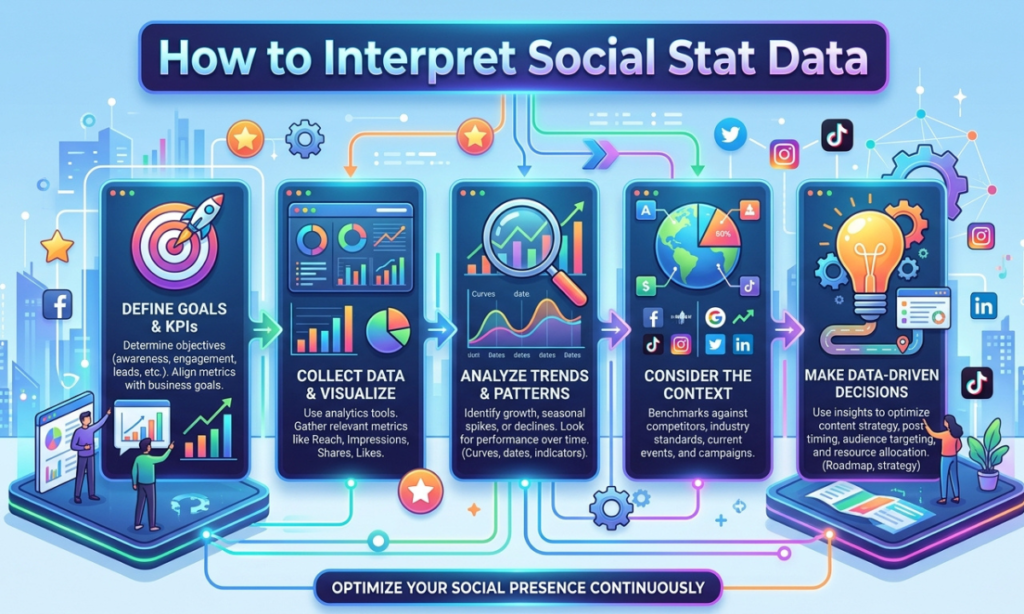
Reading the numbers correctly is just as important as collecting them. A few practical interpretation tips:
- Compare trends, not snapshots. Look at week-over-week or month-over-month changes instead of isolated numbers.
- Segment by content type. Video, images, and text posts often perform differently — separate them before drawing conclusions.
- Cross-check engagement with reach. High engagement with low reach may mean a loyal but small audience.
- Watch for outliers. A single viral post can skew averages, so review it separately from regular performance.
Factors That Influence Social Performance
Several variables affect how social stats look over time:
- Posting consistency — irregular posting often leads to inconsistent reach.
- Content quality and format — video generally drives higher engagement than static images.
- Platform algorithm changes — updates can shift visibility overnight.
- Audience relevance — content tailored to a specific audience performs better than generic posts.
- Timing — posting when your audience is most active improves engagement.
- Paid promotion — ad spend can accelerate reach beyond organic limits.
Best Practices for Better Social Media Growth
To improve the numbers behind your social stats, consider these approaches:
- Post consistently using a realistic, sustainable schedule.
- Prioritize video and interactive content where possible.
- Respond to comments and messages to boost engagement signals.
- Use analytics to identify your best-performing content types and repeat what works.
- Test posting times based on when your audience is most active.
- Combine organic content with occasional paid promotion for wider reach.
Common Challenges and How to Overcome Them

| Challenge | Practical Solution |
|---|---|
| Inconsistent engagement | Stick to a content calendar and posting schedule |
| Difficulty comparing platforms | Use platform-specific benchmarks instead of one-size-fits-all goals |
| Data overload | Focus on 3–5 core metrics instead of tracking everything |
| Slow follower growth | Prioritize engagement and shareability over follower count alone |
| Unclear ROI | Connect social metrics to website analytics and conversions |
Real-World Applications of Social Stat Insights
Beyond simple reporting, these insights get applied in several practical ways:
- Campaign planning — deciding which content formats to prioritize based on past performance.
- Budget decisions — shifting ad spend toward platforms with the strongest return.
- Content calendars — scheduling posts around historically high-engagement times.
- Customer service — monitoring sentiment and response times across channels.
- Sales tracking — connecting social traffic to actual purchases or leads for e-commerce brands.
Future Trends in Social Media Analytics
Social analytics continues to evolve, and a few trends are shaping where it’s headed:
- AI-driven predictions that forecast engagement before content is even published.
- Deeper cross-platform integration, allowing marketers to view all accounts in a single dashboard.
- Real-time sentiment analysis that goes beyond likes and comments to gauge audience mood.
- Privacy-focused analytics that adapt to changing data regulations while still delivering useful insights.
These shifts suggest that social stat tracking will become faster, smarter, and more predictive over time.
Final Thoughts on Bouncemediagroupcom Social Stat

Whether used as a specific reference or a general example, bouncemediagroupcom social stat represents a bigger idea worth understanding: social media success is measurable, and those measurements can guide smarter decisions. Anyone managing a social presence — big or small — benefits from treating these numbers as a routine part of strategy rather than an afterthought.
FAQ’s
What does “social stat” mean in a marketing context?
It refers to measurable social media data such as followers, engagement, and reach used to evaluate performance.
Is tracking social stats only useful for large companies?
No, small businesses and individual creators benefit just as much from tracking their own metrics.
How often should social stats be reviewed?
A weekly check with a deeper monthly review works well for most accounts.
Which metric matters most: followers or engagement?
Engagement usually matters more, since it reflects real audience interest rather than just audience size.
Can social stats predict future performance?
They can reveal trends and patterns that suggest future performance, though external factors can still shift results.
What tools are commonly used to track these stats?
Native platform analytics, third-party tools like Sprout Social or Hootsuite, and Google Analytics for referral traffic.
Conclusion
Understanding bounce media groupcom social stat ultimately comes down to understanding social media analytics as a whole — collecting the right data, interpreting it correctly, and using it to guide real decisions. With consistent tracking and a clear focus on the metrics that matter most, anyone can turn raw numbers into a stronger, more informed social media strategy.

A passionate content creator and the creative mind behind PrayerBright. I am dedicated to sharing meaningful prayers, heartfelt blessings, and faith-filled inspiration that bring hope, peace, and encouragement to everyday life. Through thoughtful and uplifting content, I strive to help people strengthen their faith, find comfort in God’s presence, and share messages of love and positivity with others.